Hill's Bridge
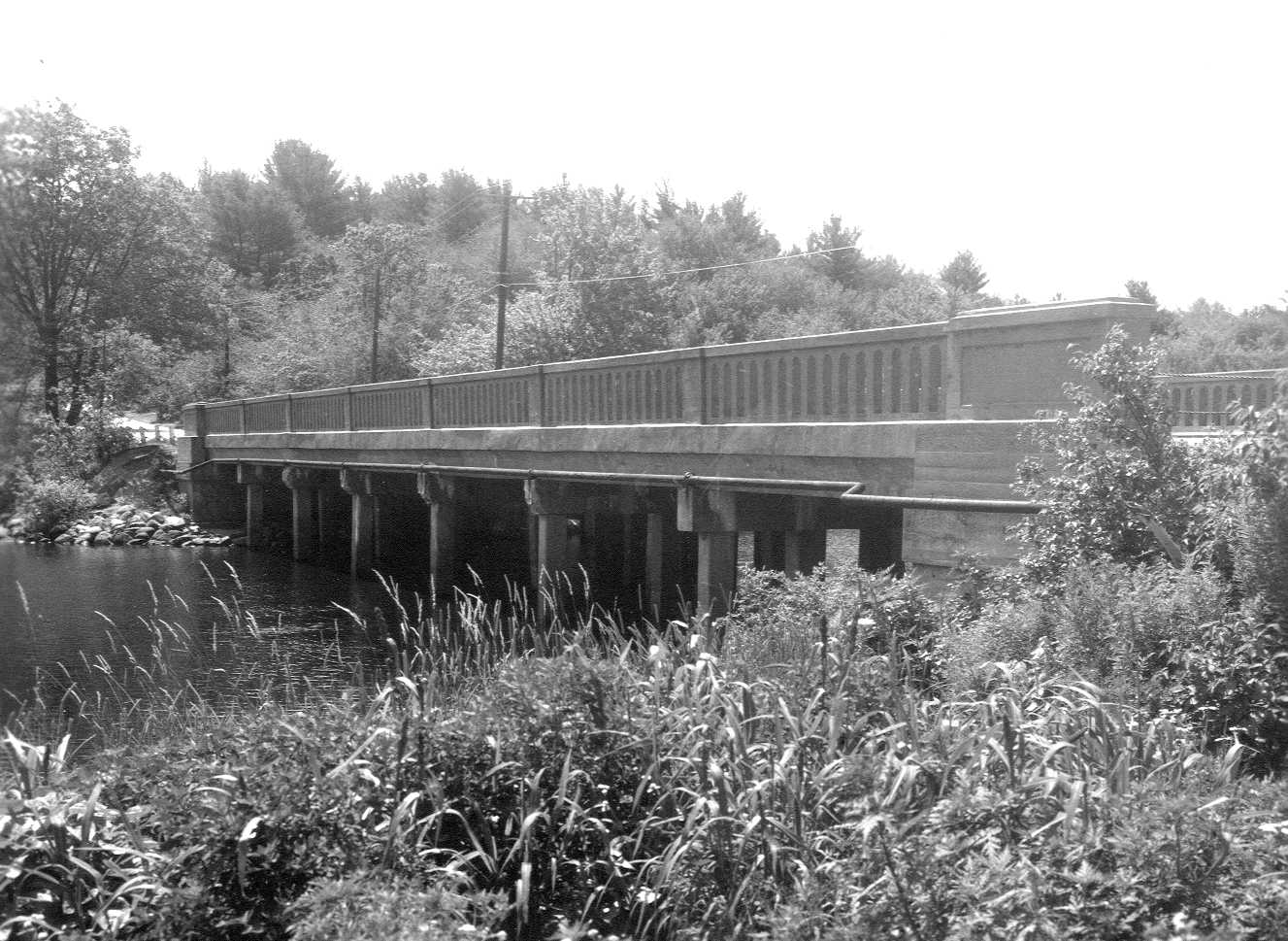
Hill's Bridge carries Nashua Road (Route 4) across the Concord River in South Billerica. It is named for Lieutenant Joseph Hill, who, Hazen thought, "probably lived on the west side of Concord River near this bridge, which he may have built for his own convenience and that of the neighborhood." Since 2010 the present bridge has officially been the John F. Leary Bridge.
The bridge first appears in the town records on July 22, 1736: "Whereas, a number of Persons in the neighboring Towns have Petitioned the General Sessions in Middx. for a highway from Westford meeting-house cross Concord River over Lt. Joseph Hill's bridge to Lexington," the town chose a committee of five "to manage that affaire in the behalfe of the Town." The Sessions evidently approved the road, for on May 16, 1737 the town told the committee "to manage the affaire in Defense of the Town," by appeal or by petition to the General Court. The town was soon called upon to pay 59 pounds 10 shillings, which implies that it lost.
After the Middlesex Turnpike opened, crossing the river a mile above the Middle Bridge, the Hill bridge and its road "fell into disuse and decay," and the bridge fell down and was not rebuilt for some time. Then travelers from Chelmsford and the towns above wanted a straighter and less hilly road to Lexington than the turnpike. Mrs. Joseph Foster gave a right of way through her land on the west side of the river, and others built one of the abutments. Most of the town disliked a road that would draw travel away from the center, and "when other means of opposition failed, some of the citizens, and, tradition affirms, some of the most respectable, determined to take the case into their own hands and proceeded to destroy the offensive abutment." It was, Hazen wrote, "perhaps the only mob known in the town." Suits followed and were decided against the town, "which was compelled to build the bridge and road and has since maintained it."
Through the 1890s and 1900s the town kept up a timber bridge: Hill & Ellinwood supplied bridge lumber in 1891, Arthur Allen made repairs in 1895, and the bridge was replanked in 1913. In 1924 the highway surveyor reported that "the Hills bridge is in very poor shape at the present time" and posted it for three tons. When Nashua Road was rebuilt as a state highway, the Massachusetts Department of Public Works built a new bridge, dated 1926 on a plaque in its railing: seven spans of 20 feet in reinforced concrete beams on concrete pile bents, 142 feet long and 42 feet wide. The town's road and bridge contracts that year came to $60,133.47, nearly all reimbursed by the state. In 1925 and 1926 Town Meeting considered lighting "Nashua Road from Hills Bridge to the Bedford line."
In 2003 the Billerica Historical Commission gave the state "historic background information on the Hill's Bridge (Rte #4) which is slated for replacement." The Massachusetts Highway Department's contract (project 603424) began on July 14, 2006 and replaced the abutments and piers while two lanes of traffic stayed open; it was completed in 2009 at a contract value of $4,955,265. The new bridge, of continuous steel beams about 158 feet long, was named the John F. Leary Bridge by Chapter 186 of the Acts of 2010, approved July 27, 2010.
References
- MACRIS BIL.911
- Hazen, History of Billerica (1883): Hill's bridge and the highway petition of 1736-1737
- Hazen, History of Billerica (1883): the destruction of the new abutment of the Hill bridge by a mob
- Hazen, History of Billerica (1883): the Middlesex Turnpike crossing Concord River a mile above the centre bridge
- Annual Report 1913: Highway Surveyor, replanked Hill's Bridge
- Annual Report 1924: "The Hills bridge is in very poor shape," posted for three tons
- Annual Report 1926: Nashua Road and Bridge contracts and state reimbursement
- Annual Report 2003: Historical Commission background on Hill's Bridge, slated for replacement
- Annual Report 2009: Nashua Road Bridge replacement completed
- MassDOT project 603424: Bridge Replacement, B-12-001, Route 4 (Nashua Road) over Concord River
- Acts of 2010, Chapter 186: designating bridge B-12-001 in Billerica as the John F. Leary Bridge